leanroutine.online – Learn how to build strength at home without equipment using practical, sustainable methods that support long-term fat loss and real-world consistency.
Most people don’t fail at home workouts because they lack motivation. They fail because they don’t know what getting stronger actually looks like without dumbbells, machines, or a gym.
You start with push-ups and squats, feel sore for a week, then plateau. The scale barely moves. The routine becomes repetitive. Eventually, you stop.
The real issue isn’t effort. It’s the lack of a clear progression strategy.
If your goal is to build strength at home while supporting sustainable fat loss, you need more than random workouts. You need a structured way to challenge your body over time, even without equipment.
This is where most home routines fall short and where a smarter approach makes all the difference.
Why Strength Training Matters More Than Cardio for Fat Loss
It’s tempting to rely on cardio when fat loss is the goal. Running, cycling, or long HIIT sessions feel productive because they burn calories quickly.
But the results rarely last.
Strength training changes that equation. When you build muscle, your body becomes more efficient at using energy, even at rest. This means you’re not just burning calories during a workout you’re improving your baseline metabolism.
At home, this matters even more. You don’t have access to heavy weights, so your advantage comes from consistency and smart intensity.
The mistake many people make is treating bodyweight exercises as light training. In reality, movements like push-ups, lunges, and planks can be incredibly demanding if structured correctly.
Without strength progression, fat loss often stalls. Your body adapts quickly. What felt hard in week one becomes easy by week three.
The goal isn’t to do more workouts. It’s to make each workout more effective.
The Biggest Mistake Doing the Same Routine Every Week
One of the most common patterns in home workouts is repetition without progression.
You follow a YouTube routine. You repeat it every day. After a few weeks, it feels easier but nothing changes physically.
That’s not progress. That’s adaptation without stimulus.
To build strength at home, your body needs a reason to improve. That means gradually increasing difficulty over time.
Here’s what progression actually looks like in a home setting:
Slower movement tempo
Increased time under tension
More challenging exercise variations
Reduced rest between sets
Better control and range of motion
For example, a basic push-up can evolve into:
Slow push-ups (3–4 seconds down)
Pause push-ups (hold at the bottom)
Decline push-ups (feet elevated)
Archer push-ups or single-arm variations
Each step forces your muscles to adapt.
Without this, your workouts become maintenance not transformation.
How to Structure a Strength-Focused Home Routine
A good home routine isn’t about doing everything. It’s about doing the right movements consistently.
You don’t need dozens of exercises. You need a core structure that covers your entire body.
At minimum, your routine should include:
Push movements chest, shoulders, triceps
Pull movements back, biceps often improvised at home
Lower body quads, glutes, hamstrings
Core stability
The challenge is balance. Many home routines overemphasize legs and core while neglecting upper body pulling movements due to lack of equipment.
This is where creativity matters.
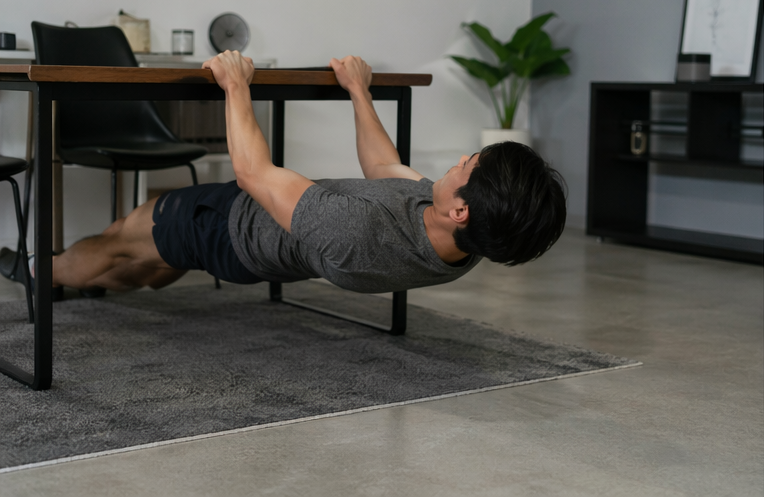
You can simulate pulling with:
Towel rows using a sturdy door
Backpack rows loaded with books
Floor-based pulling variations
If you’re unsure how to combine these effectively, a structured plan like this simple weekly structure for home fat loss training can help you stay consistent without overthinking.
The key is not variety it’s progression within a stable framework.
Realistic Progression Without Equipment

One misconception about home training is that progress is limited. That’s only true if you rely on repetition instead of progression.
Strength gains at home come from increasing difficulty, not just increasing reps.
Here’s how progression works in practice:
1. Tempo Control
Slowing down movements increases muscle tension significantly.
A squat done in 2 seconds is very different from one done in 5 seconds down and 2 seconds up.
This method requires no equipment but dramatically increases intensity.
2. Range of Motion
Partial reps are easier. Full range of motion is harder.
Deep squats, full push-ups, and controlled lunges challenge your muscles more effectively and safely.
Skipping this step is a common mistake that limits results.
3. Unilateral Training
Single-leg or single-arm movements double the difficulty instantly.
Examples:
Bulgarian split squats
Single-leg glute bridges
One-arm push-up progressions
These movements build strength faster because they remove compensation from the stronger side.
4. Density Training
Doing the same amount of work in less time increases intensity.
For example:
Week 1: 4 sets in 20 minutes
Week 3: Same 4 sets in 15 minutes
This improves both strength and conditioning.
If you need a clearer structure, this efficient full-body schedule for busy days breaks down how to organize progression without adding complexity.
When Home Strength Training Stops Working
There’s a point where many people feel stuck. Workouts feel harder, but results don’t improve.
This usually happens for one of three reasons:
1. Lack of Recovery
Training harder doesn’t always mean training better.
If you’re constantly sore or fatigued, your body isn’t rebuilding stronger. It’s just surviving the workload.
Strength requires recovery.
2. Poor Exercise Execution
Form matters more at home because you don’t have external resistance guiding the movement.
Small mistakes like shallow squats or rushed push-ups reduce effectiveness over time.
Filming your workouts or slowing down reps can help correct this.
3. No Progressive Overload
Repeating the same routine indefinitely leads to stagnation.
Even slight adjustments tempo, angles, volume can reignite progress.
If your upper body feels particularly stuck, focusing on a targeted plan like this practical routine to improve pushing strength can help break through plateaus.
Not every solution is about doing more. Sometimes it’s about doing things differently.
Making Strength Training Fit Real Life
The biggest advantage of home training isn’t convenience. It’s adaptability.
You don’t need to block 90 minutes. You don’t need perfect conditions.
You can train in:
20–30 minute sessions
Small spaces
Between work tasks
Without commute time
But this flexibility can also become a trap.
Without structure, workouts become optional. And optional habits rarely stick.
To make build strength at home sustainable, your routine needs to fit your real life not an ideal version of it.
That means:
Choosing realistic training frequency (3–4 times per week is enough)
Accepting shorter sessions over skipping entirely
Focusing on consistency over intensity
The goal isn’t to maximize effort every day.
It’s to maintain a level of consistency your future self can sustain.
Why Strength First Leads to Better Fat Loss Outcomes
Fat loss isn’t just about burning calories. It’s about preserving muscle while reducing body fat.
Without strength training, your body often loses both.
This leads to:
Slower metabolism
Softer body composition
Easier weight regain
When you focus on strength, fat loss becomes a byproduct not the sole objective.
You don’t just lose weight. You improve how your body looks and functions.
This is especially important for long-term results.
Extreme calorie deficits and excessive cardio may produce quick changes, but they’re rarely sustainable.
Strength-based routines, on the other hand, create a foundation you can build on for years.
The Mindset Shift That Changes Everything
Most people approach home workouts with a temporary mindset.
They want quick results. Fast fat loss. Visible changes in a few weeks.
That approach leads to frustration.
Building strength especially without equipment is slower. But it’s more reliable.
You’re not chasing intensity. You’re building capability.
Each week, your movements become stronger. More controlled. More efficient.
Over time, this compounds.
What starts as a basic push-up becomes a challenging variation. What feels impossible becomes manageable.
That’s progress you can measure and sustain.
And once strength becomes part of your routine, fat loss stops feeling like a constant struggle.
It becomes a natural outcome of how you train and live.