leanroutine.online – Doing the same home workout every day may affect fat loss progress depending on intensity, recovery, and long-term adaptation patterns.
For many people trying to lose weight at home, consistency feels like the safest strategy. You find a routine that works, repeat it daily, and assume the repetition will steadily move the scale in the right direction. But when progress slows—or stops entirely—it’s common to wonder whether doing the same home workout every day is part of the problem.
Fat loss is not only about effort. It’s also about how the body adapts to repeated stimuli. When a routine becomes predictable, your metabolism, muscles, and nervous system respond differently than they did in the first few weeks. Whether that slows fat loss depends on several practical variables: training intensity, recovery capacity, calorie balance, and long-term programming.
This article focuses specifically on the physiological and practical implications of repeating the same home workout every day—and how to determine whether it’s helping or limiting your results.
Why the Body Adapts Faster Than Most People Expect

When you start a new workout routine, your body experiences a novel stressor. Heart rate increases more dramatically, muscles fatigue faster, and calorie burn is relatively high compared to your fitness level at that moment.
However, the human body is highly adaptive. Within weeks, several changes occur:
Improved neuromuscular efficiency
Lower heart rate response to the same movements
Reduced perceived exertion
More efficient energy usage
In practical terms, this means you may burn fewer calories performing the exact same routine at the same intensity after several weeks. The workout feels easier because your body has become more economical.
That efficiency is beneficial for performance and endurance. But for fat loss—where energy expenditure matters—it can reduce the metabolic impact of the session unless intensity or structure changes over time.
This doesn’t mean repetition is inherently bad. It means static programming has limits.
Fat Loss Depends on More Than Workout Variety
It’s important to separate two ideas: metabolic adaptation and fat loss fundamentals.
Fat loss ultimately depends on sustained energy balance. If calorie intake consistently exceeds expenditure, body fat increases. If expenditure exceeds intake over time, body fat decreases.
A same home workout can still support fat loss if:
It maintains sufficient intensity
Total daily movement outside workouts remains adequate
Nutrition aligns with fat loss goals
However, when people experience plateaus, it’s often due to a combination of factors:
Reduced non-exercise movement (NEAT)
Slight increases in calorie intake
Decreased training intensity as the routine becomes familiar
A broader framework for structuring home-based training, especially when gym access is limited, is explored in a practical weight loss plan designed for busy professionals training at home. That approach emphasizes progressive structure rather than relying solely on repetition.
The key issue is not sameness alone—it’s lack of progression.
The Role of Progressive Overload in Home Workouts
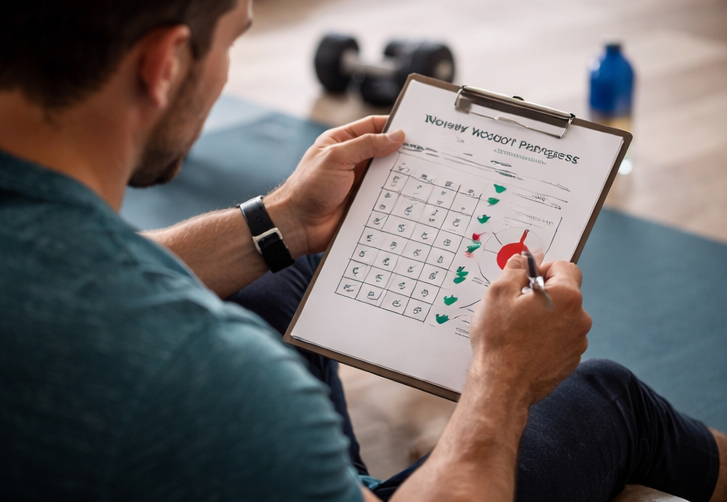
Progressive overload is the principle of gradually increasing training demand over time. In gym settings, this often means adding weight to barbells or machines. At home, it requires more creativity.
If you repeat the same home workout every day without changing any variables, progressive overload may stall. Over time, this can reduce both muscle stimulus and calorie expenditure.
At home, overload can be created through:
Increasing repetitions
Reducing rest time
Slowing tempo
Adding resistance bands or dumbbells
Incorporating more challenging movement variations
Increasing total workout duration
Without some form of progression, your body stops adapting. When adaptation stops, improvements in strength, endurance, and metabolic demand level off.
This doesn’t mean you must constantly change exercises. It means the workload must evolve.
Daily Repetition and Recovery Constraints
Another overlooked factor is recovery.
Many home workouts rely heavily on bodyweight circuits: squats, push-ups, lunges, planks, and jumping movements. While these appear low risk compared to heavy lifting, they still create muscular and nervous system fatigue.
If you perform the same high-intensity circuit daily without recovery variation, several issues may emerge:
Chronic muscle soreness
Decreased power output
Reduced workout intensity
Elevated fatigue levels
When fatigue accumulates, performance drops. Lower performance means lower energy expenditure during the session. Over time, this can subtly reduce fat loss efficiency.
Recovery is not just for athletes. It directly influences the quality of your training sessions. If every workout is moderate to high intensity with no variation, you may be limiting output rather than maximizing it.
Is Routine Beneficial for Adherence
While adaptation can reduce calorie burn, routine can significantly improve adherence.
Behavioral consistency is one of the strongest predictors of long-term fat loss success. Repeating the same home workout removes decision fatigue. You know exactly what to do, how long it takes, and how it fits into your schedule.
For busy professionals, especially those balancing remote work or family responsibilities, predictability increases compliance. And compliance often matters more than theoretical optimization.
The trade-off becomes clear:
High consistency from routine
Lower stimulus if no progression
If repeating the same home workout keeps you exercising five to six days per week instead of quitting after two weeks of constantly changing programs, that stability has measurable value.
The challenge is keeping the structure while adjusting the intensity.
When a Same Home Workout Can Slow Fat Loss
There are specific scenarios where repeating the same workout daily is more likely to limit results.
The Intensity Never Increases
If heart rate stays in a low range and repetitions remain unchanged for months, the caloric demand of the workout decreases relative to your improved fitness level.
Muscle Stimulus Is Insufficient
Fat loss is supported by preserving lean muscle mass. If your routine becomes too easy, muscle maintenance signals decline, potentially affecting metabolic rate over time.
You Compensate Outside the Workout
Some people unconsciously move less during the day after exercising. If the routine becomes easy, daily movement may decline without you noticing.
Calorie Intake Gradually Rises
Improved fitness sometimes increases appetite. If nutrition drifts upward while workout intensity remains constant, fat loss slows—even if the routine hasn’t changed.
In these cases, stagnation isn’t caused solely by repetition. It’s the interaction between adaptation, behavior, and energy balance.
How to Modify Without Replacing the Routine
If you prefer structure and familiarity, you don’t need to abandon your workout entirely. Instead, adjust specific variables while keeping the foundation.
Consider rotating intensity across the week:
2 days higher intensity
2 days moderate strength focus
1 lighter mobility or recovery session
You can also alternate duration. Some individuals benefit from comparing shorter daily sessions with longer, more demanding workouts spaced further apart. The trade-offs between those approaches are examined in an analysis of daily short workouts versus longer weekend sessions for fat loss, which highlights how volume distribution influences results.
The point is strategic variation, not randomness.
Metabolic Efficiency and Calorie Burn Reality
A common misconception is that doing the same workout automatically reduces fat loss to zero. That is not physiologically accurate.
Calorie burn declines gradually as efficiency improves, but it does not disappear. If the workout remains moderately challenging, it still contributes to total daily energy expenditure.
The bigger issue is expectation mismatch. Early weight loss often includes water loss and rapid glycogen depletion. Later stages rely on consistent fat oxidation, which progresses more slowly.
When scale movement slows, people often blame the routine. In reality, fat loss becomes more incremental as body composition improves.
That said, metabolic adaptation is real. The body may slightly reduce resting energy expenditure during prolonged calorie deficits. Combining static workouts with prolonged dieting without variation can compound this effect.
Psychological Factors in Perceived Plateaus
There is also a cognitive component. When you repeat the same home workout daily, you may begin to underestimate its difficulty because it feels familiar.
Familiarity reduces perceived effort. Lower perceived effort can unconsciously reduce actual effort. You may:
Shorten rest slightly
Skip final repetitions
Move with less explosiveness
Rush through sets
The structure is technically the same, but the stimulus declines.
Filming a session or tracking time-to-completion can reveal whether intensity has subtly dropped over time.
When Repetition Is Actually the Right Strategy
In some cases, repeating the same home workout daily is appropriate:
Beginners building foundational movement patterns
Individuals prioritizing habit formation
People returning from injury
Those with limited cognitive bandwidth
For beginners especially, neuromuscular coordination improves significantly in the first 4–6 weeks. Repeating movements during that period enhances motor learning and reduces injury risk.
The key is adding gradual progression once technique stabilizes.
A Practical Decision Framework
If you’re evaluating whether your same home workout is slowing fat loss, ask:
Has performance improved over the last 4 weeks?
Are repetitions, tempo, or resistance increasing?
Is daily movement outside workouts stable?
Is calorie intake consistent?
Do sessions still feel moderately challenging?
If the answer to most of these is yes, the routine is likely still productive.
If performance has plateaued and intensity feels significantly lower than when you began, structured variation may help reintroduce stimulus.
Fat loss at home does not require constant novelty. It requires sufficient stimulus, progressive demand, and sustainable structure. Repetition becomes limiting only when it eliminates progression or compromises recovery.
The question is not whether you’re doing the same workout every day. The more relevant question is whether your body still has a reason to adapt.