leanroutine.online – Simple home workouts can support sustainable weight loss when structured correctly around consistency, recovery, and realistic energy balance.
Sustainable weight loss rarely depends on intensity alone. For most adults in the United States—especially those balancing work, family responsibilities, and limited discretionary time—the more relevant question is not how hard a workout is, but whether it can be repeated consistently for months.
That’s where simple home workouts become practical. They reduce friction. There’s no commute to a gym, no membership fees, and no dependence on specialized equipment. But simplicity does not automatically translate to effectiveness. The real value lies in how these workouts are structured and how they interact with recovery, daily activity, and dietary habits.
This article examines how to design and use simple home workouts specifically to support long-term, sustainable weight loss—not short bursts of rapid change, but measurable, maintainable progress.
Why Simplicity Improves Long-Term Adherence
In behavioral research, complexity is often the enemy of consistency. The more steps required to begin a habit, the more likely it is to be skipped under stress or time pressure. For working adults in the U.S., average weekly work hours and commuting time can make structured gym programs difficult to sustain.
Simple home workouts lower three key barriers:
Time cost (no travel or locker room time)
Financial cost (no monthly membership or equipment purchases)
Decision fatigue (clear, repeatable routines)
From a physiological standpoint, weight loss depends on sustained energy balance over time. A moderately challenging routine performed four days per week for a year is more impactful than a high-intensity program performed for six weeks and abandoned.
Simplicity supports adherence, and adherence drives outcomes.
The Role of Progressive Overload in Basic Bodyweight Routines 
A common misconception is that home workouts are inherently limited because they lack heavy equipment. While resistance training machines and barbells provide structured load increases, bodyweight training can still create progressive overload when applied strategically.
Progression does not require more equipment; it requires deliberate adjustment.
Methods to Progress Without Equipment
Increase Repetitions
Gradually raise the number of reps per set.
Increase Time Under Tension
Slow down the lowering phase of movements like squats or push-ups.
Reduce Rest Periods
Shorter recovery intervals increase metabolic demand.
Advance Movement Variations
Move from incline push-ups to floor push-ups, then to decline or single-leg variations.
These adjustments stimulate muscular adaptation. Preserving lean muscle mass is critical during weight loss because muscle tissue supports resting metabolic rate. When weight is lost without resistance stimulus, a portion can come from muscle, which may reduce long-term energy expenditure.
For those new to structured exercise, a broader overview of training structure and weekly planning can be found in this structured approach to exercising at home for fat reduction, which outlines scheduling considerations for busy professionals.
Designing a Weekly Framework That Supports Fat Loss

Effective simple home workouts should fit into a repeatable weekly structure. A common and practical framework includes:
3–4 resistance-focused sessions
1–2 light cardio or active recovery days
1–2 rest days
This format balances stimulus and recovery while accommodating unpredictable schedules.
Sample Weekly Layout
Monday: Full-body strength (20–30 minutes)
Tuesday: Brisk walking (30 minutes)
Wednesday: Lower-body emphasis (25 minutes)
Friday: Upper-body and core (20–25 minutes)
Weekend: Optional light activity (cycling, walking, mobility)
Notice that none of these sessions require specialized equipment. The emphasis is on compound movements:
Squats
Lunges
Push-ups
Glute bridges
Planks
Step-ups (using stairs)
Compound exercises recruit multiple muscle groups simultaneously, increasing total energy expenditure per session.
Intensity vs. Sustainability
High-intensity interval training (HIIT) is often marketed as the fastest path to fat loss. While it can be effective, it is not always sustainable for individuals who are deconditioned, overweight, or managing joint issues.
For many adults, moderate-intensity strength circuits combined with daily walking may be more sustainable and equally effective over time.
Why Moderate Intensity Often Works Better
Lower injury risk
Better recovery capacity
Reduced burnout
Higher long-term adherence
Walking deserves specific mention. In the U.S., average daily step counts remain below recommended levels for many adults. Increasing daily steps to 8,000–10,000—without extreme workouts—can meaningfully increase total daily energy expenditure.
Simple home workouts should complement daily movement, not replace it.
Energy Balance: The Missing Context
Exercise contributes to weight loss, but it rarely overrides dietary patterns. Sustainable fat loss requires a modest, consistent calorie deficit.
However, aggressive calorie restriction often backfires. Severe cuts can lead to fatigue, reduced training performance, and eventual overeating. Instead, pairing simple home workouts with moderate dietary adjustments tends to produce steadier outcomes.
A helpful framework for balancing activity with realistic nutrition adjustments is discussed in this guide on maintaining weight loss without extreme calorie restriction, which emphasizes avoiding metabolic slowdowns and rebound weight gain.
The interplay between training stimulus and dietary intake matters:
Resistance training signals the body to preserve muscle.
Moderate calorie reduction allows fat loss.
Adequate protein intake supports recovery.
Sleep regulates hunger hormones such as ghrelin and leptin.
Without these elements aligned, workouts alone rarely produce meaningful long-term change.
Recovery and Hormonal Considerations
Sustainable weight loss is not only about calories burned during workouts. Chronic stress and inadequate recovery can impair progress.
Sleep
Adults in the United States average less than the recommended 7–9 hours of sleep per night. Sleep deprivation increases hunger signals and reduces insulin sensitivity. Even well-designed simple home workouts can be undermined by insufficient rest.
Stress Load
Cortisol levels rise under chronic stress. While cortisol alone does not cause belly fat, prolonged stress can increase appetite and reduce recovery capacity. Overtraining—particularly with daily high-intensity sessions—may compound this issue.
Simple home workouts should feel challenging but manageable. Persistent soreness, sleep disruption, and declining performance signal excessive volume or intensity.
Cost and Accessibility in the U.S. Context
Gym memberships in the United States can range from approximately $10 per month at budget facilities to $70 or more at boutique studios. Personal training sessions often cost $50–$100 per hour depending on location.
For individuals prioritizing financial efficiency, home-based training eliminates recurring fees. Minimal equipment such as resistance bands or adjustable dumbbells can be added later if desired, but they are not required at the outset.
In addition, many Americans live in regions with extreme weather conditions—heat in the Southwest, snow in the Northeast—which can limit outdoor exercise. Home workouts reduce seasonal disruption.
Accessibility also matters for individuals with limited transportation or caregiving responsibilities. Removing logistical barriers increases the likelihood that exercise remains consistent during life transitions.
Common Mistakes That Limit Results
Even well-intentioned routines can stall progress if certain principles are overlooked.
Inconsistent Scheduling
Skipping sessions repeatedly disrupts progression. Treating workouts as non-negotiable appointments improves compliance.
Lack of Progression
Repeating identical workouts for months without increasing challenge reduces stimulus. Gradual progression is necessary.
Overestimating Calorie Burn
Wearable devices often overestimate energy expenditure. Relying on inflated calorie numbers can lead to overeating.
Ignoring Daily Activity
A 25-minute workout cannot offset prolonged sedentary behavior. Non-exercise activity thermogenesis (NEAT)—walking, standing, household tasks—plays a substantial role in total energy expenditure.
Unrealistic Timelines
Healthy weight loss typically averages 0.5–1% of body weight per week. Expecting faster change may lead to unnecessary intensity increases or extreme dieting.
Measuring Progress Beyond the Scale
The scale provides useful data, but it does not capture the full picture. With resistance-focused simple home workouts, body composition may improve even when scale weight changes slowly.
Additional metrics to track:
Waist circumference
Clothing fit
Strength progression (e.g., push-ups per set)
Resting heart rate
Energy levels
Improvements in strength and stamina often precede visible fat loss. Tracking performance can reinforce adherence when scale changes are gradual.
When to Modify or Advance the Routine
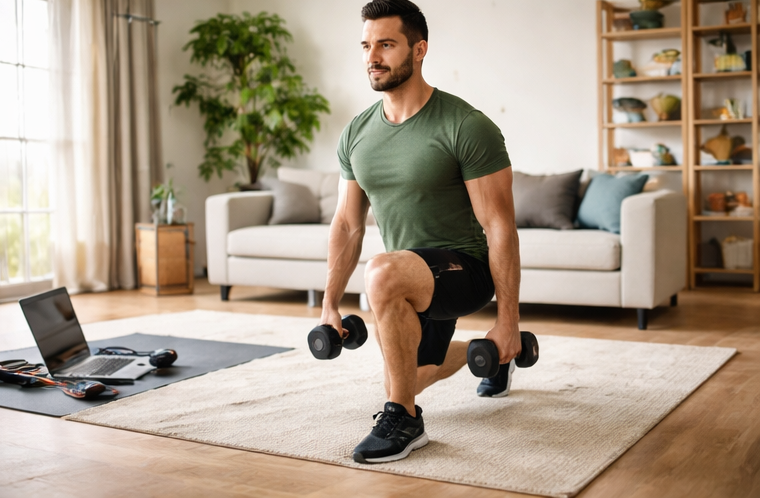
As conditioning improves, the initial routine may become insufficient. Signs that it’s time to progress include:
Minimal muscle fatigue after sessions
No increase in repetitions over several weeks
Stable body weight despite consistent diet and activity
At that stage, adding resistance bands, adjustable dumbbells, or weighted backpacks can increase stimulus without requiring a gym.
However, more complexity is not always necessary. For many adults, steady progression within bodyweight training remains effective for extended periods.
Practical Expectations for Sustainable Results
Simple home workouts are not a shortcut. They are a structural tool that makes consistent training feasible within real-world constraints.
Over 3–6 months, consistent application can lead to:
Gradual fat loss
Improved muscular endurance
Enhanced metabolic health markers
Better mobility and joint stability
The key variable is not novelty. It is repetition with incremental progression.
Sustainable weight loss is less about dramatic transformation and more about reliable systems. Simple home workouts, when paired with moderate dietary awareness and adequate recovery, form one of the most practical systems available for long-term results.