leanroutine.online – Finding time for structured workouts can feel unrealistic when workdays are packed with meetings, deadlines, and family responsibilities. For many busy adults, the idea of committing to hour-long gym sessions several times a week simply does not align with daily life. This is where walking indoors every day enters the conversation.
The question is not whether walking is healthy. It is whether walking indoors, done consistently and intentionally, can meaningfully support sustainable weight loss for adults with limited time. The answer depends less on intensity and more on structure, consistency, and how it fits into broader lifestyle habits.
This article explores how daily indoor walking works, what makes it effective or ineffective for weight loss, and what busy professionals should realistically expect from this approach.
Why Walking Indoors Every Day Appeals to Busy Adults
Time efficiency is the primary driver behind the growing interest in indoor walking routines.
Unlike commuting to a gym or coordinating outdoor sessions around weather conditions, indoor walking removes logistical friction. It can be done in:
A living room
A hallway
On a treadmill
During a video call
Between work blocks
This accessibility lowers the psychological barrier to exercise. When an activity requires minimal setup, consistency becomes more realistic.
For adults balancing demanding schedules, walking indoors every day offers:
Predictable scheduling
Zero travel time
Minimal equipment
Lower injury risk compared to high-impact workouts
However, convenience alone does not guarantee weight loss. The key lies in understanding how walking influences energy expenditure and metabolic balance.
How Walking Indoors Contributes to Calorie Deficit
Sustainable weight loss ultimately depends on maintaining a consistent calorie deficit over time. Walking, including indoor walking, contributes by increasing daily energy expenditure.
Energy Burn from Indoor Walking
The number of calories burned depends on:
Body weight
Walking pace
Duration
Incline (if using a treadmill)
For example, a moderate indoor walk of 30–45 minutes can burn a meaningful number of calories, especially when done daily. While the burn per session may appear modest compared to high-intensity workouts, the cumulative effect over weeks and months becomes significant.
Daily moderate movement often leads to better adherence than intense but inconsistent sessions.
The Role of NEAT (Non-Exercise Activity Thermogenesis)
Walking indoors every day also increases NEAT — the energy burned from daily movement outside structured exercise.
For busy professionals who spend long hours sitting, increasing low-intensity movement can:
Improve metabolic flexibility
Support blood sugar regulation
Reduce prolonged sedentary time
In many cases, increasing daily movement may be more sustainable than relying solely on short, intense workouts.
For those developing a broader strategy, integrating walking into a structured system like our complete home workout plan for weight loss can add consistency and direction without requiring a gym membership.
What Makes Walking Indoors Effective for Sustainable Weight Loss
Not all walking routines produce the same outcomes. The effectiveness of walking indoors every day depends on several factors.
1. Duration and Frequency
Consistency matters more than occasional intensity.
A realistic starting point for busy adults may be:
20–30 minutes daily
Or multiple 10-minute sessions spread throughout the day
Short sessions accumulated across the day can be just as beneficial as one continuous walk.
2. Intensity Management
While casual strolling has health benefits, moderate-intensity walking typically produces stronger metabolic effects.
Indicators of moderate intensity include:
Slightly elevated heart rate
Light sweating
Ability to speak in short sentences but not sing
Some individuals use incline walking or light weighted vests, but these adjustments should be gradual and appropriate for fitness level.
3. Progressive Overload
Even with walking, the body adapts.
To maintain progress over time, adjustments may include:
Increasing duration
Slightly increasing pace
Adding incline (if using a treadmill)
Incorporating interval walking
Without progression, calorie expenditure may plateau.
Practical Implications for Busy Professionals

For professionals with limited time, indoor walking can influence more than just weight.
Time Efficiency
Because indoor walking removes commute and setup time, a 30-minute walk truly takes 30 minutes. That predictability supports adherence.
Some people combine walking with:
Audiobooks
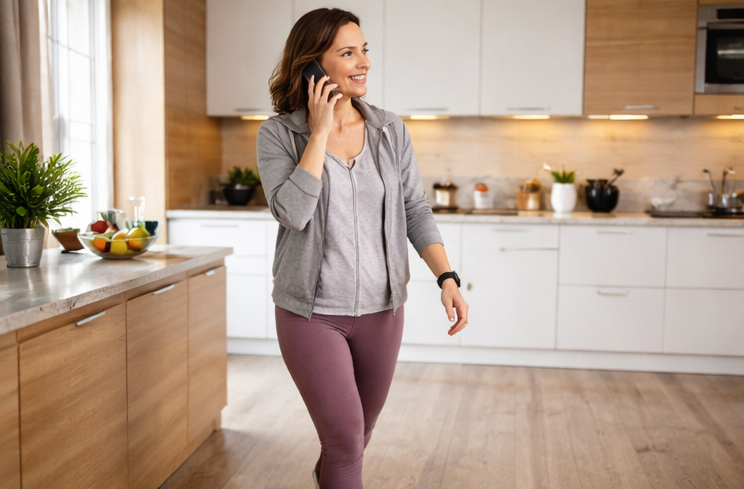
Work calls
Language learning
Light household tasks
This pairing can make the habit more sustainable.
Financial Considerations
Walking indoors requires minimal investment. Options range from:
Walking in place with no equipment
Using online guided walking sessions
Purchasing a treadmill
Compared to gym memberships or boutique fitness classes, indoor walking can be financially accessible, which supports long-term consistency.
Lower Injury Risk
High-impact exercise can lead to joint strain, especially for individuals returning to fitness after long sedentary periods. Walking indoors provides a lower-impact alternative, making it suitable for many adults seeking gradual change.
However, footwear, posture, and surface stability still matter to avoid repetitive strain.
Limitations and Realistic Expectations
Walking indoors every day can support sustainable weight loss, but it has limitations.
Calorie Burn Is Moderate
Walking alone may not create a large calorie deficit unless paired with mindful nutrition.
Weight loss is more predictable when walking is combined with:
Adequate protein intake
Portion awareness
Reduced ultra-processed food consumption
Relying solely on walking without addressing dietary patterns may slow results.
Adaptation Over Time
As fitness improves, the same walking routine burns fewer calories. Without gradual progression, results may stall.
Muscle Preservation Considerations
Walking primarily trains lower-body endurance. It does not significantly stimulate upper-body muscle growth or preserve muscle mass during weight loss.
For long-term body composition goals, incorporating resistance training—even short home sessions—can be beneficial.
Approaches to Make Indoor Walking More Effective
For those committed to walking indoors every day, small adjustments can improve results without adding significant time.
Structured Intervals
Alternating between moderate and slightly faster paces increases cardiovascular demand.
Example structure:
3 minutes steady
1 minute brisk
Repeat
This approach can elevate calorie burn within the same time frame.
Habit Stacking
Pairing walking with an existing habit increases adherence.
Examples:
Walking during daily news viewing
Walking immediately after lunch
Scheduling a walking block between meetings
Consistency often depends on environmental cues.
Tracking Without Obsession
Using step counters or activity trackers can provide feedback, but excessive focus on numbers may create unnecessary pressure.
For many busy adults, aiming for a daily movement target—rather than a strict step count—can feel more sustainable.
Considerations Before Making It a Daily Routine
Before committing to walking indoors every day, several factors deserve attention.
Medical Conditions
Individuals with:
Joint issues
Cardiovascular conditions
Balance concerns
should consult a healthcare professional before increasing daily activity.
Recovery and Fatigue
While walking is low impact, overuse without rest can still cause strain, particularly for beginners.
Gradual progression helps prevent discomfort in:
Knees
Hips
Lower back
Lifestyle Alignment
The most effective routine is one that integrates seamlessly into daily life.
If indoor walking feels forced or disruptive, alternatives such as cycling, bodyweight circuits, or mobility sessions may be more suitable.
Can Walking Indoors Every Day Truly Be Sustainable
Sustainability depends less on intensity and more on behavioral consistency.
Walking indoors every day:
Requires minimal preparation
Fits into tight schedules
Carries low injury risk
Is financially accessible
These characteristics increase the likelihood of long-term adherence.
For busy adults, the true value lies in establishing a daily movement baseline. When walking becomes automatic, it supports not only calorie balance but also stress regulation, energy levels, and routine stability.
However, sustainable weight loss usually results from layered habits:
Consistent movement
Balanced nutrition
Adequate sleep
Stress management
Walking indoors can serve as a foundation within that broader system.
Over time, small daily energy expenditures accumulate. A modest daily calorie deficit sustained over months can lead to measurable progress without extreme dieting or exhaustive workouts.
For professionals seeking a realistic entry point into fitness, walking indoors every day offers a practical starting strategy. It may not produce rapid transformations, but it can support steady, manageable change—particularly when integrated into a structured home-based plan that aligns with demanding schedules.
In many cases, the simplest routine is the one most likely to endure.