leanroutine.online – Balancing a full-time job with personal health goals can feel like a constant negotiation. Many professionals start exercising at home with strong motivation, only to abandon their plan after a few weeks because it clashes with meetings, deadlines, or family responsibilities.
Creating a Sustainable Home Workout Schedule is not about squeezing random workouts into leftover time. It requires a realistic structure that respects your work rhythm, energy patterns, and long-term commitments. When done thoughtfully, a home workout routine can complement your professional life rather than compete with it.
This article focuses specifically on building a sustainable schedule that works alongside a full-time job—not on choosing exercises or equipment, but on designing a structure you can maintain consistently.
Understanding What Sustainable Really Means in a Work Context
Sustainability in fitness is often misunderstood. It does not mean intense sessions every day. It does not mean maximum efficiency. It means continuity.
For full-time professionals, sustainability has three core elements:
Predictability – You know when you will train.
Flexibility – The plan adapts to busy days.
Recoverability – Missing one session does not derail the entire system.
A schedule becomes unsustainable when it depends on ideal conditions: perfect sleep, zero overtime, and unlimited motivation. Real work life includes unexpected calls, urgent tasks, and fluctuating mental energy. Your workout structure must anticipate these realities.
Instead of asking, When can I fit exercise in? a better question is, At what time of day am I consistently most in control of my schedule?”
For many professionals, that answer determines long-term success.
Identifying Your Most Reliable Time Window
The foundation of a Sustainable Home Workout Schedule is not the type of training—it is the timing.
Morning Before Work
Morning workouts reduce the risk of schedule conflicts. Before emails and meetings begin, your time is often more predictable. However, this option requires disciplined sleep habits. Cutting sleep to exercise can eventually undermine productivity and recovery.
Morning sessions tend to work well for:
Professionals with fixed office hours
People who experience decision fatigue in the evening
Individuals who prefer completing important tasks early
Lunch Break Sessions
Short sessions during lunch can be effective, particularly for remote workers. The key is efficiency and clear boundaries. A 20–30 minute focused session is often more sustainable than a long midday workout that adds stress.
This option is practical if:
You work from home
Your lunch break is consistent
You can return to work without rushing
Evening After Work
Evening workouts are popular but often disrupted by fatigue or social commitments. They work best when the workout acts as a mental transition from work to personal time.
If you choose evenings:
Keep sessions realistic in duration
Avoid overly demanding routines after long workdays
Maintain a clear stopping time to protect sleep
The goal is not to find the “best” time universally. It is to find the most stable window in your specific weekly routine.
Designing a Weekly Structure That Matches Your Energy, Not Just Your Calendar

A common mistake is scheduling workouts based only on availability. A more effective approach considers energy distribution across the week.
Most full-time professionals experience:
Higher mental clarity earlier in the week
Accumulated fatigue by Thursday or Friday
Variable motivation depending on workload
A sustainable schedule might look like:
2 moderate sessions early in the week
1 shorter, lower-intensity session later in the week
Optional light mobility or stretching on weekends
This structure respects natural energy fluctuations rather than fighting them.
For readers looking for a broader framework on how home workouts fit into weight management goals, our home workout plan for busy professionals provides helpful context on how scheduling connects with overall results. The key difference here is the focus: sustainability over intensity.
Your weekly structure should feel repeatable. If you look at next week’s calendar and feel tension, the plan may be too ambitious.
Preventing Schedule Collapse During Busy Periods
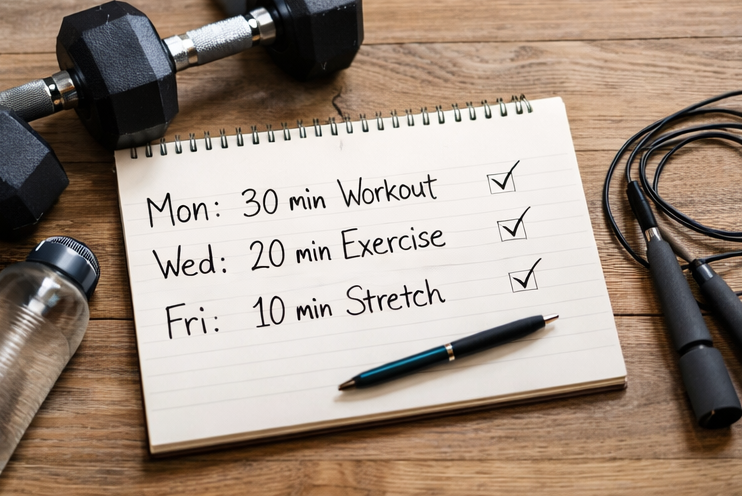
Even the most carefully designed plan can fall apart during peak work cycles. The difference between temporary disruption and total abandonment lies in preparation.
Build a Minimum Effective Version of Your Routine
Instead of viewing workouts as all-or-nothing, define:
A full session (e.g., 40 minutes)
A reduced session (e.g., 20 minutes)
A micro session (e.g., 10 minutes of focused movement)
When deadlines intensify, switching to a reduced or micro version maintains continuity. This preserves the habit loop, which is often more important than session length.
Pre-Commit to a Weekly Minimum
For example:
No matter what, I will complete two sessions this week.
This reduces guilt and decision fatigue. Overcommitting creates pressure; realistic minimums build consistency.
Avoid Overcompensation
Missing a workout does not require doubling the next session. Overcorrection often leads to exhaustion, especially when combined with professional stress. A Sustainable Home Workout Schedule favors steady rhythm over dramatic recovery efforts.
Managing Mental Fatigue From Work

Physical availability is only part of the equation. Cognitive fatigue significantly affects exercise consistency.
After long hours of problem-solving or decision-making, motivation declines—not because of laziness, but because of depleted mental resources.
Strategies to manage this include:
Reduce Friction Before the Workout
Keep workout clothes ready.
Use a simple, repeatable routine.
Minimize decision-making about exercises.
When preparation is automatic, less willpower is required.
Shorten the Activation Barrier
Commit to starting for just five minutes. Often, beginning is the hardest step. Once in motion, continuation becomes easier.
Separate Work and Exercise Mentally
If working from home, create a brief transition ritual:
Change clothes immediately after logging off.
Step outside briefly before returning to exercise.
Play consistent music that signals workout time.
This mental boundary prevents work stress from blending into your training session.
Considering Financial and Time Implications
Sustainability also relates to cost and time efficiency.
A schedule that requires extensive equipment, subscription platforms, or constant program changes can become financially and mentally draining.
When evaluating your routine, consider:
Does it require additional purchases?
Does it depend on external schedules?
Does it extend into time reserved for family or recovery?
A simple structure—bodyweight training, basic equipment, or repeatable circuits—often reduces friction and long-term cost.
Time investment should also be realistic. Three well-planned 30-minute sessions per week can be more sustainable than five one-hour sessions that regularly get canceled.
Adjusting the Schedule as Your Work Demands Change
Full-time work is rarely static. Promotions, new projects, travel, or seasonal workloads may require structural adjustments.
Instead of abandoning your plan during these transitions, reassess:
Has your available time window shifted?
Has your energy level changed?
Does session length need temporary reduction?
A Sustainable Home Workout Schedule evolves. For example:
During travel-heavy months, prioritize short bodyweight sessions.
During intense project cycles, reduce frequency but maintain consistency.
During lighter work periods, increase intensity gradually.
This adaptive mindset protects long-term progress.
Avoiding Common Structural Mistakes
Even motivated professionals often encounter similar obstacles.
Scheduling Too Many Sessions
Ambition can overshadow realism. Starting with five weekly sessions after months of inactivity rarely lasts. Gradual progression is more reliable.
Ignoring Recovery
Full-time work already imposes cognitive and sometimes physical strain. Without adequate sleep and recovery days, performance at both work and workouts can decline.
Treating Every Session as High Intensity
High-intensity training has benefits, but relying on it exclusively increases burnout risk. A mix of moderate and lighter sessions supports sustainability.
Lacking a Clear Weekly Plan
Improvising daily may seem flexible, but it often leads to inconsistency. Even a simple weekly template provides structure without rigidity.
Long-Term Perspective: Building Identity, Not Just a Schedule
A Sustainable Home Workout Schedule ultimately supports something deeper: identity alignment.
When exercise becomes part of how you define yourself—not an extra task competing with work—it integrates more naturally into your routine.
Professionals who maintain long-term consistency often:
View exercise as non-negotiable personal maintenance
Accept fluctuations without abandoning the system
Focus on consistency over rapid transformation
The schedule is simply the framework. Sustainability comes from realistic expectations and structural adaptability.
As your career evolves, your routine can evolve with it. The objective is not perfection. It is continuity that coexists with professional ambition.
By designing your workout schedule around real constraints—energy, time, workload—you create a system that supports both health and career performance without forcing either to suffer.